Architectural Skin
Modular GFRC & studio ceramic · interior and exterior
The wall, treated as coastal geography. On the envelope, wind, salt, and solar tracking weather the shore into pattern; in the room, sound, light, and touch do the same work over time. Composed in concrete and ceramic, those forces settle into the wall as rhythm. Four series translate that logic — from geometric repetition to site-specific relief.
Honeycomb House, Suiderstrand — Series 01 · GFRC Hex field in progress · under construction
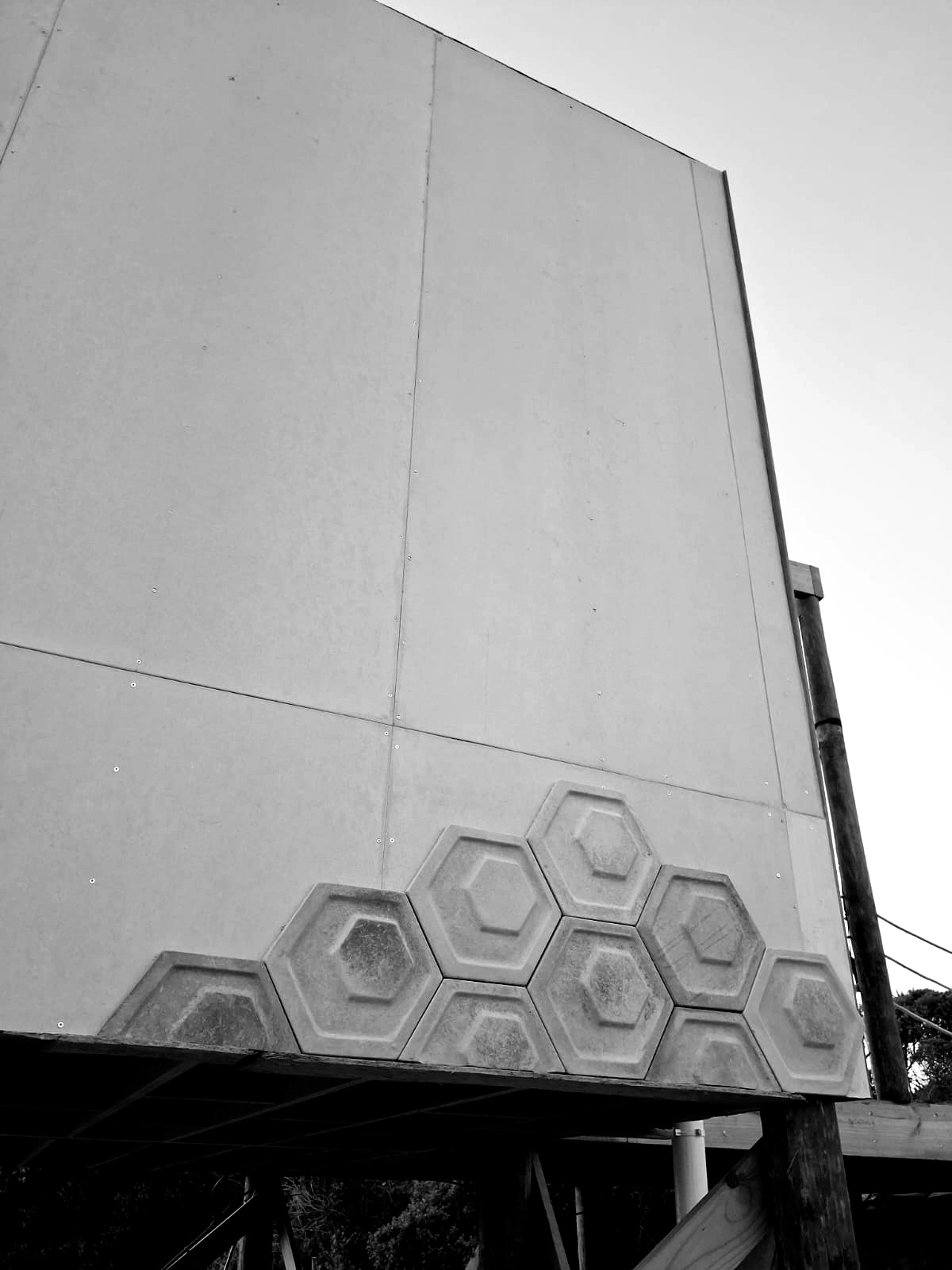

Series 01 · GFRC Hex — module macro, Quarry Raw. Nine per square metre laid.
The Modular Index
The index records the studio’s surface research: live series, series in development, and series reserved. Each is cast or fired to commission; none is stocked.
Series 01 · GFRC Hex
Hexagonal cast concrete with a micro-organic honeycomb imprint. Nine modules to the square metre; laid point-up or flat-up. Specification →
LiveSeries 02 · Ceramic Hex
Kiln-fired glazed ceramic, 15 cm hexagon. Coastal glaze range — saturated colour, impervious surface. Register interest →
In developmentSeries 03 · GFRC Linear
Rectangular GFRC batten module. Reserved for the next casting cycle.
ReservedSeries 04 · Singular
Site-specific sculptural surface in ceramic or GFRC, executed to brief. One wall, one commission. Commission →
LiveThe unique utterance
Where Series 01 provides the grammar of the field, Singular is the sentence spoken once. A site-specific relief sculpted by hand and cast in GFRC or ceramic, translating one coastal memory or one architectural brief into a permanent tectonic landmark.
- One wall, one commission
- Sculpted to the volume’s light and acoustics
- Cast in GFRC or studio ceramic
Series 01 · GFRC Hex
In nature, the hexagon is the economy of the shore: the coral cup, the barnacle plate, the abalone nacre. Series 01 extracts that geometry into a structural skin with an off-centre focal point — a deliberate organic bias rather than a mechanical grid.
The recessed bed carries a micro-organic honeycomb imprint impressed while the concrete is still green — a relief within the module that catches ambient light across the field and ensures the surface is never merely flat.
Cell logic — schematic, not to scale. The same sealed geometry, two ways to lay it: A point-up, B flat-up.
Configure it below — orientation, patina and lay are previews; the cast field is mixed and laid by hand.
Series 01 · GFRC Hex — Configurator
Compose the Field
One uniform cell, repeated until the wall becomes a field. Turn it the way your wall wants it and preview its patina.
Patina is an indicative preview — the real finish is mixed by hand. “Hand-laid” breaks the machine-perfect repeat, tile by tile. Tilt is for composition only; the buildable orientations are point-up and flat-up.
Point up
The hexagon on its point — the offset rows read as rising columns of cells.
Flat up
The hexagon on its edge — the offset rows read as horizontal courses.
An indicative visualisation — orientation and patina are previews; the cast field is mixed and laid by hand, so no two are alike.
Cape Cache · The Surface · Series 01
Dimensions, substrate requirements, fixing details, lead times, and sample requests — see the Series 01 technical specification.
Architectural Contexts
The Exterior Envelope: Deployed at Honeycomb House in Suiderstrand, modulating solar glare and breaking the mass of large elevations.
The Interior Anchor: Feature walls behind hearths, circulation corridors, and hospitality vestibules where tactile relief softens acoustic reflection.
Specify the Surface
We work directly with architects, designers and private clients across all four series — patina, orientation and fixing resolved to the wall, its height and its use. Specification packs include module drawings, fixing details and patina samples.
Direct
- Studio
- Cape Cache, Pearly Beach, Western Cape
- info@capecache.co.za
- Visits
- By appointment — studio gallery & Honeycomb House
- Trade
- Architects & interior studios — specification packs on request