
Ghost Whale
The Repurposed Line · Wall Reliefs
14 mm laid nylon topline, diverted from Cape Town harbours and bound into the anatomical form of a cetacean fluke. A material transition from maritime utility to architectural relief.
Description
Ghost Whale: The Repurposed Line is formed from 14 mm laid nylon topline — standardised gear diverted from Cape Town harbours before it reached landfill or the sea. Because this gear completed its commercial service rather than failing at sea, its provenance is singular.
The salt-faded grey of the working line is kept whole and uncorrected, preserving the physical record of its maritime use. Bound by hand around an armature built in A1 (Acrylic One), the rope maps the hydrodynamics of the fluke while retaining the exact colour, texture, and weight of its industrial past.
The whale fluke is the hydrodynamic surface of departure — the last structure visible before the body submerges. The whale was the first great marine commodity, rendered into oil, bone, and baleen for export, and the beaches where this rope was once deployed are the same coast where whaling stations operated at Gansbaai and De Kelders. Binding the standardised tool of the fishing industry into this shape turns the mechanism of extraction into the anatomy of the extracted.
Engineered for wall-mounted placement. The 1.2-metre wingspan of the fluke requires broad vertical planes or double-volume architecture, interacting with the surrounding volume through its 220 mm depth and the cast shadow it produces under ambient light.
Specification
- Medium
- 14 mm laid nylon topline
- Framework
- A1 (Acrylic One) mineral-acrylic composite armature, hand-built
- Format
- Wall-mounted relief
- Scale
- Whale Tails ≈ 1250 × 1070 × 220 mm (≈ 49 × 42 × 9 in)
- Status
- One work available · Others placed in private collections
Process — Transmutation
Diverting 14 mm laid nylon topline from Cape Town harbour waste streams.
Power-washing each length to remove salt, grime, and working-life residue.
Sun-dried until stable. The salt-faded grey is kept whole, uncorrected.
Hand-building the A1 (Acrylic One) armature to carry the anatomical load.
Laying and binding the topline strand by strand around the armature, following the anatomical load, then fringing the margins.
Studies — Exhibition & Detail


Provenance
- Artist
- Ché Hough (Cape Town)
- Studio
- Cape Cache, Pearly Beach, Western Cape
- Field Research
- 139,500 nautical miles at sea
- Execution
- 2025–2026 — Pearly Beach Studio
- Authentication
- Certificate of Authenticity issued by Cape Cache
Related in This Typology

Ghost Tide
Cold-cast aluminium dolphin in ghost netting — the precursor that documented the threshold moment.
View the work →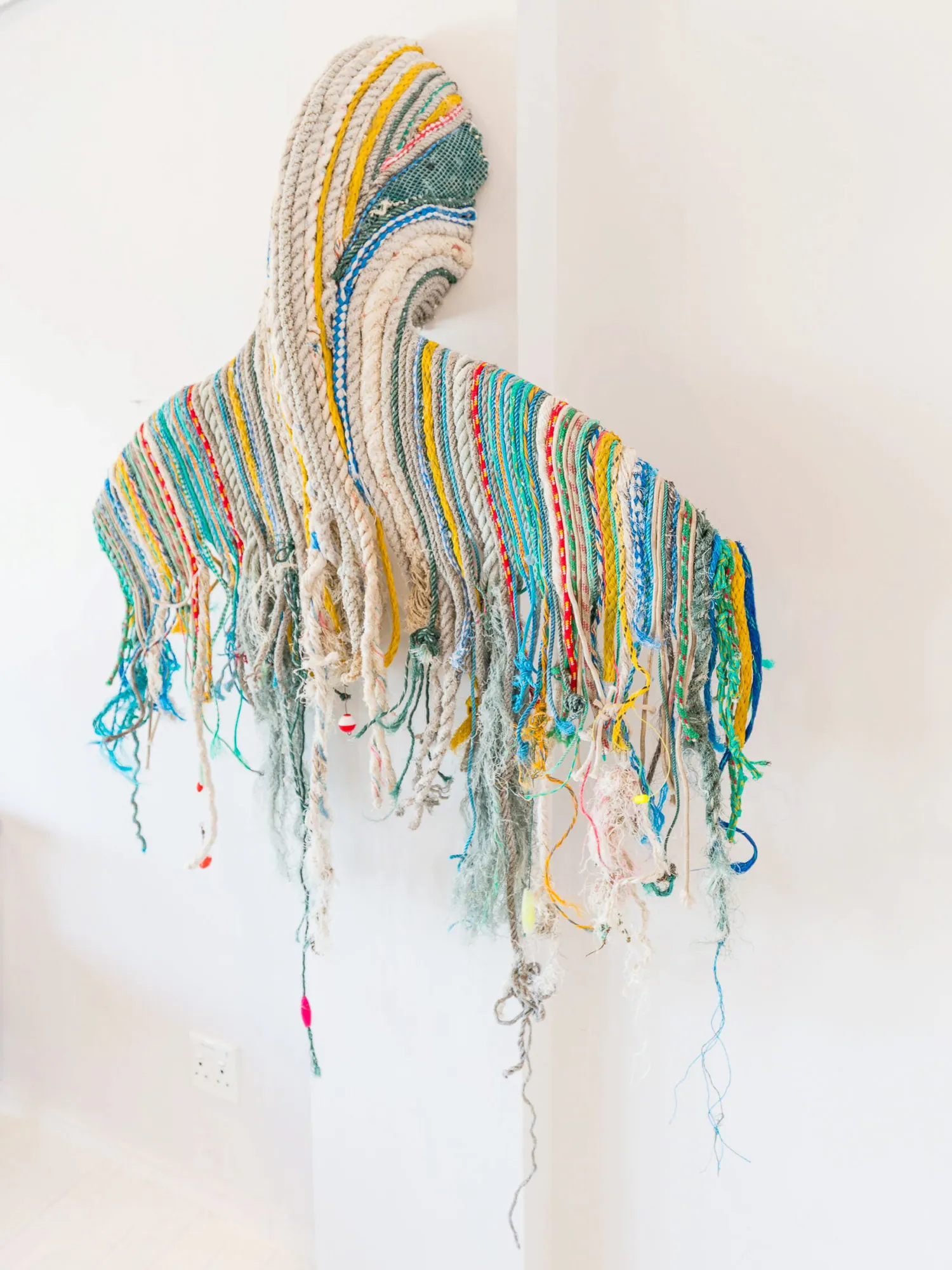
Ghost Tales — The Collected Rope
Mixed flotsam fibres gathered from the beaches between Pearly Beach and Walker Bay. The same transmutation, following the logic of circulation.
View the work →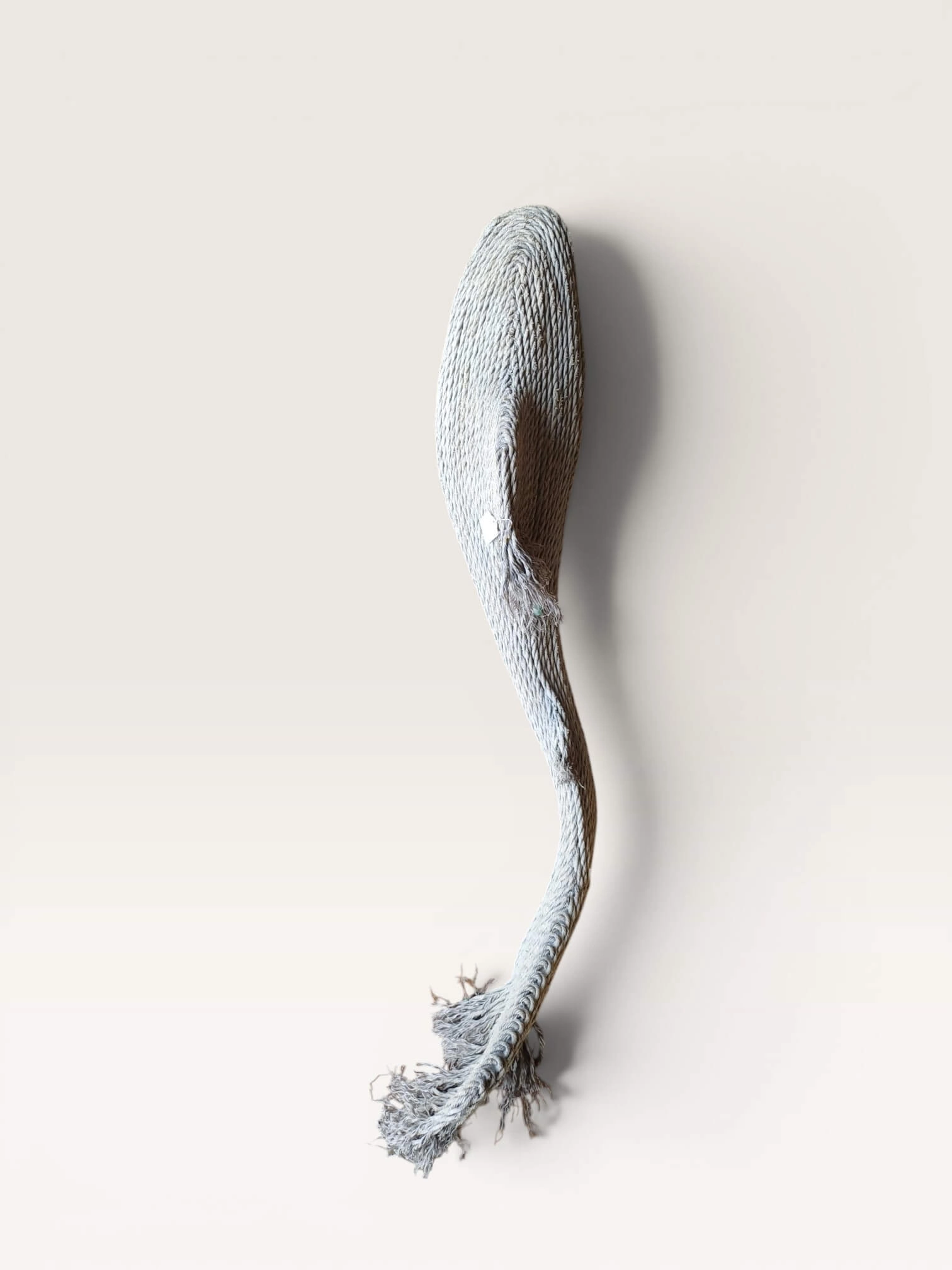
Ghost Shark
14 mm laid nylon topline bound into the anatomical form of a shark mid-breach. The standardised tool of extraction mapped as the body of the extracted.
View the work →One work in The Repurposed Line is available for immediate acquisition. Future works continue the transmutation of harbour-sourced topline into new wall reliefs. Trade documentation via the Architectural Specification Index.
Acquisition Enquiries