Position 2 of 18 · Unique work · Thyrsites atun · Zeesnoek

Anatomy of Velocity II
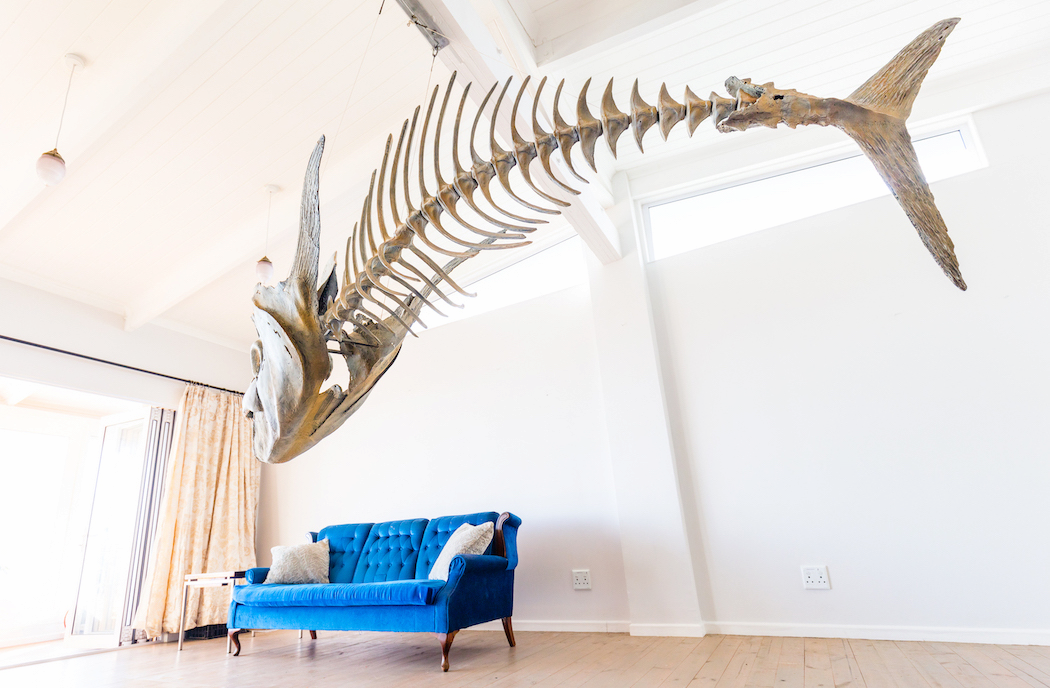
A double-volume architectural space demands an anchor that can survive height without becoming distant. Suspended from above, the Zeesnoek skeleton does not occupy the void; it commands it.
The Specimen — Detail


A unique work in pure white — conceived for double-volume and industrial-scale interiors.
Material & Specification
- Medium
- Water-based mineral resin
- Method
- Every vertebra, rib, and tooth shaped by hand
- Finish
- Pure white
- Rigging
- Dyneema® SK99 or structural steel arch
- Scale
- ≈ 3000 × 600 × 900 mm
- Edition
- Unique work
The Spatial Mirror
Strip away the flesh and what remains is the line of force: teeth, jaw, thrust. It brings oceanic space to the vertical space. The ceiling becomes surface light, the floor becomes depth, and the expansive void is gathered into an immutable focal anchor.
At three metres, the skeleton carries the profound architectural presence of a monumental form without the physical mass of bronze or stone. Every vertebra, rib, and tooth is sculpted entirely by hand in water-based mineral resin, articulated along the line of the strike from jaw to tail.
Colophon & Provenance
- Typology
- I · The Frame — The Specimens
- Artist
- Ché Hough (Cape Town)
- Studio
- Cape Cache, Pearly Beach, Western Cape
- Field Research
- 139,500 nautical miles at sea
- Execution
- 2025 — Pearly Beach Studio
- Status
- Unique work · Currently exhibited at Dallas Smith Gallery, Plettenberg Bay
- Authentication
- Certificate of Authenticity issued by Cape Cache
Process — Vertebra by Vertebra
Dissecting Thyrsites atun to map the line of the strike.
Shaping every vertebra, rib, and tooth by hand in water-based mineral resin.
Articulating the skeleton bone by bone, following the natural geometry of the ambush.
Finished in pure white, vertebra by vertebra.
Suspending on Dyneema® SK99 or grounding in a structural steel arch.
Anatomy of Velocity
The tuna skeleton — the companion study, a different species, a different velocity. Three meters of hand-formed structure capturing the architecture of speed.
View the work →